

playing with beliefs
revisiting the old, and moving with the new.



Below are two individual reflections, challenging previous personal beliefs, and creating a new path forward.
Maybe by reading this - you will do the same.
the act of playing is familiar to most of us.
an action where the mind and body escape their confines.
an act that sits outside of time.
and yet somehow with time, we play less as we age.
because play may not be an act of balance.
it employs both order and chaos in ways that blur each other.
an oscillation.
to play in the midst of it all.
we seek, and speak about balance as the pinnacle of being.
however the more we experience being, we speak in terms of -
“seasons”
“phases”
“periods”
these are not descriptions of balance.
they are attempts to describe experienced oscillation.
and to oscillate at will, without thought - is to play.
maybe in our attempts to find balance - we lose our ability to play 🌱
I feel as though my head is a mess of datapoints. I have always mentally operated in a logical way. To explain something, to have a conversation, to produce an output, I connect the granular pieces into a whole. Art feels so fascinating, so unattainable to me, since it breaks this model. There are no facts or conclusions, it is up to us to interpret our own. Art is starting from the whole and working backwards to its pieces.
In that way, I love trying to create art (often poorly) and step out of this logical, first principles brain. Writing is my favourite form of art. I’m most inspired by Ernest Hemingway, who balances this so well - he distills descriptions into their absolute simplest form, so the reader is left at the very precipice of being able to infer meaning from the words.
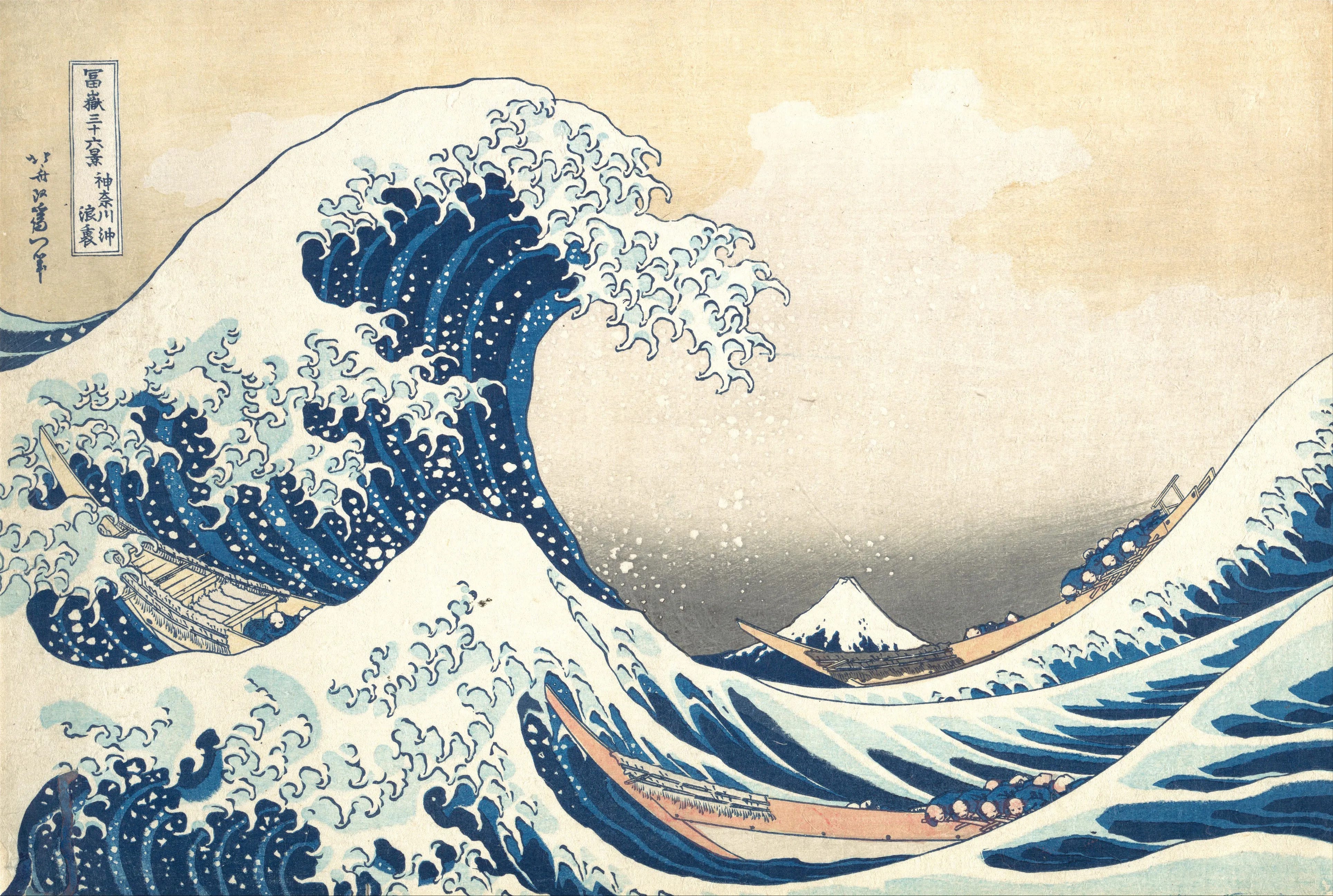
To me, logic is droplets of water, and art is the crashing wave. Both beautiful and simple in their own right, one the first principles and the other the final piece. Art is the whole. It has no explanation, it is complete. We each sub-divide it down into its pieces, from our own perspective, to interpret it.
The most extreme version of logic we have are the universe’s first principles. Planck’s constant, the speed of light, absolute zero. These are physical laws that we don’t know how to subdivide any further. This collection of rules is what defines the atoms of the Mona Lisa. Or the cells of the trees in the Amazon. The beautiful simplicity of sieving our universe down into a handful of constants pushed humans throughout history towards art, religion, the unknown, and the all-encompassing and inexplicable forces that exist. Repeatedly, we asked ourselves whether this planet was formed by the universe and its gravity or the art of a creator.
At their closest inspection, they are the same thing.
‘The more I study science, the more I believe in God’* - Albert Einstein
*”This quote is often misused to claim that Einstein was religious. In fact, God here refers to Spinoza’s God, the idea that God and Nature are one and the same.”
I was drawn to art because it escapes logic, and in doing so, found they are family 💙
 | A guest post by
|
this is a masterpiece
you are wonderful ✨ 🖼️ 💕